Various Questions
(Answered by person in parentheses)
Question: What
is the rail weight along the Alaska Railroad?
Answer: I
just called the railroad heavy equipment man who has been traveling with
the
track gangs for the past three seasons and asked what size rail they are
laying now. All "New" construction is to be 141 pounds to the Yard.
Most everywhere you see concrete ties will be 141. North of Curry there
are some concrete
ties with 115 pounds to the Yard remanufactured rail but not much. (It takes
different ties and fasteners to do the two sizes.) There is some 90 pounds
to
the Yard used on sidings, stub and Yard tracks but not much. He believes
all the 75 pound rail is now gone. (Pat Durand) 6/27/09
Question: Does
the Alaska Railroad heat their fuel tanks?
Answer: EMD
engines by their nature heat their fuel tanks. Fuel is fed to the injectors
at a rate much higher than what they need, the excess being used to cool
them.
This hot fuel is then dumped back into the tank, warming it. Even the
Florida East Coast's engines work that way. The Alaska Railroad does
have fuel oil preheaters which are thermostatically controlled heat exchangers
that use cooling water to heat cold fuel after it leaves the fuel pump and
before it goes to the injectors.
Furthermore, their batteries have built in heaters.
This feature is unusual, but it is not unique to the Alaska Railroad.
The only protection they have for the cooling system is the winterization
hatch. EMD engines cannot have antifreeze in the cooling water.
They are too prone to leakage and coolant in the lube oil (a common problem)
would be catastrophic to the silver wrist pin bearings if that coolant contained
antifreeze. And speaking of the lube oil, no heat is provided.
In applications where oil pan heaters are used, it is for the purpose of
reducing wear at the time of cold start. EMDs cannot be started cold. Its
the nature of the beast. (Anonymous)
Question: Does the Alaska
Railroad ever haul auto racks?
Answer: Yes, the auto racks
only show up sporadically and appear to only come on the CN barges. A
while
back when SeaLand and TOTE had union contract problems in Seattle, one dealer
(at least) decided to send his trucks and cars to Alaska via the CN barge
as Seattle was tied up with the strike. This seemed to work well for the
dealer and they continue to get new vehicles this way. They do get
mostly trucks. You will see many different road names such as CN, ATSF,
BN, Conrail, DRGW,
CP and CSX auto rack. (Jeff Childs)
Question: How was the Alaska Railroad involved in
the diphtheria serum delivery in 1925?
Answer: On January 26, 300,000 units were discovered
in Anchorage Railroad Hospital, when the chief of surgery, John Beeson,
heard
of the need. At Governor Bone's order, it was packed and handed to conductor
Frank Knight, who arrived in Nenana on January 27. While not sufficient
to
defeat the epidemic, the 300,000 units could hold it at bay until the larger
shipment arrived. The first musher in the relay was "Wild Bill"
Shannon, who was handed the 20 pound (9 kg) package at the train station
in Nenana on January 27 at 9:00 PM AKST by Knight.
"The Alaska Railroad played a critical role
during the famed Diphtheria epidemic at Nome in January and February 1925.
Public
attention riveted on the dog team replay dash carrying the antitoxin - man
and malamute racing against time through the frozen north. The contributions
of others were less known. Dan Sutherland, the territorial delegate, received
word of the epidemic at Washington, D.C. He requested help from Smith
(Noel
Smith, ARR General Manager), who was also in Washington. Smith wired the
purchasing agent in Seattle to telegraph the Chief surgeon at Anchorage,
who was in turn
instructed to place diphtheria serum on board the train for Nenana. The antitoxin
arrived at Nenana the next day, on January 27 and was transferred to the
dog
team." (Railroad in the Clouds)
Question: Has their ever been a head on collision?
Answer: The first and only head on collision on the
Alaska Railroad occurred on October 19, 1943 when northbound freight Extra
901 collided head on with southbound train #553. Both locomotives were
badly damaged, two freight cars were completely wrecked and many other cars
received minor damage. One passenger and three employees were slightly
injured. (Bernadine Prince)
Question: What is the most
unusual railroad accident?
Answer: A bridge at milepost
138.7 is a reminder of one of the most tragic accidents that ever occurred
on the ARR. In the spring of 1959, a rail motor car collided with a
tie tamper. The motor car operator jumped to safety without injury.
Unfortunately, the impact reverse the car, disengaged the brake and opened
the accelerator. The car gained speed, flew around a curve and struck
three men killing them instantly.
At milepost 117, a broken cable from a winch and cable
operation snapped and wrapped around a set of telephone and power lines
next
to the railroad. This cause a short circuit which burned up telephone
equipment and caused phones to ring many miles up the line. At milepost
159.8, an employee answered the ringing phone and at the same time stepped
on a metal plate on the floor of a railcar. He was instantly electrocuted.
(Bernadine Prince)
Question: Why is the passenger
train pulled by both an SD70MAC and a GP40?
Answer: The Alaska Railroad
passenger cars need electrical power for lights, intercom, kitchen, heat
and
air conditioning. Since these passenger cars don't generate their own
electricity, they get it from Head End Power (HEP) units. The HEP
equipped baggage cars, when they work, are barely enough power for the
train.
If they try running too many electrical items on the train at once they have
brown outs. SD70MACs are not equipped with HEP so an additional unit with
HEP (GP40-2's 3009, 3010, 3011, F7B 1503 or E8B P-30) is added. Note
that Westtours and Princess cars have their own generators and thus are
self
supporting (John Combs)
Question: What was the largest
snowfall along any part of the Alaska Railroad?
Answer: In 1956, 72 feet
of snow fell in Whittier. (Pat Durand)
Question: How is the track
laid?
Answer: Before track
is laid the right-of-way must be cleared, leveled and the road ballasted.
Here gravel is used as ballast for the base of the roadbed. In some
parts of Alaska the foremost maintenance problem is the sinking of the roadbed.
On top of a well ballasted bed, the ties are laid. In the rush to construct
the railroad, untreated spruce trees were used because they were readily
available
at low cost. Today all ties are treated with a protective coating.
However, hardwood ties are used on curves where there is much more stress
while cheaper more available softwood ties are laid on the straight always.
Rails come in various weights ranging from 55 to 136 pounds. This weight
designation indicates pounds per yard. When the Alaska Railroad was
built in 1915 through 1923 55 and 75 pound rails were used. This
light weight rail warped easily because Alaska's extreme winters and permafrost
hasten wear on the track. These rails were replaced in the early 1950s
by 115 pound rail. Today, all mainline track on the Alaska Railroad
is 136 pound rail. Gauge describes the distance between the rails
measured from inside to inside. The width of narrow gauge is three
feet, standard gauge is 4 feet, 8 1/2 inches and wide gauge measures five
feet from rail
to rail. In the earliest days of the Alaska Railroad surplus cars and
engines from the Panama Railroad had to be converted from five foot wide
gauge
to standard gauge in order to operate here. (Potter sign board)
Question: What is termination
dust?
Answer: Termination dust,
the local term for snow covering the high mountains, signaling the end
of
summer. (Randy Thompson)
Question: How many moose
were killed in a single day by one locomotive?
Answer: "An Alaska Railroad
freight train on a run between Anchorage and Fairbanks hit and killed
twenty-four
moose in a single night. I've been here fourteen years and I can't remember
anything like it," said Arnold Polancheck, assistant general manager of
the railroad. "Normally you hit one or two on a trip." (New York Times)
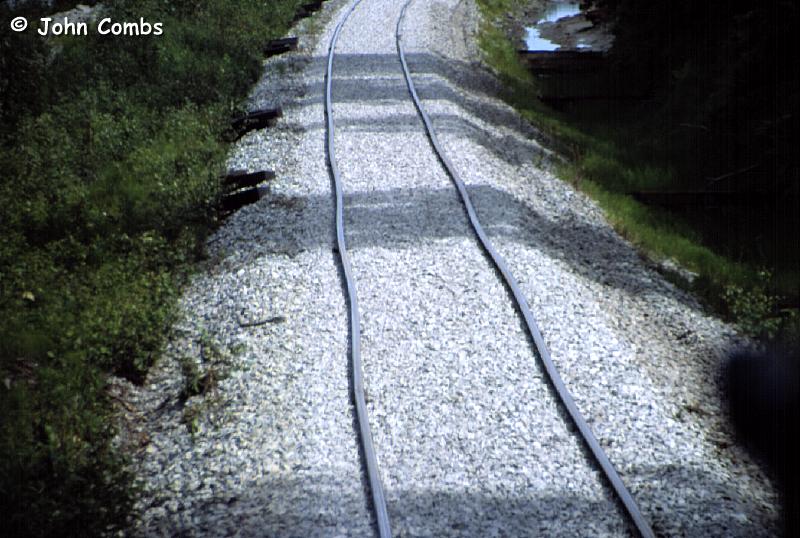
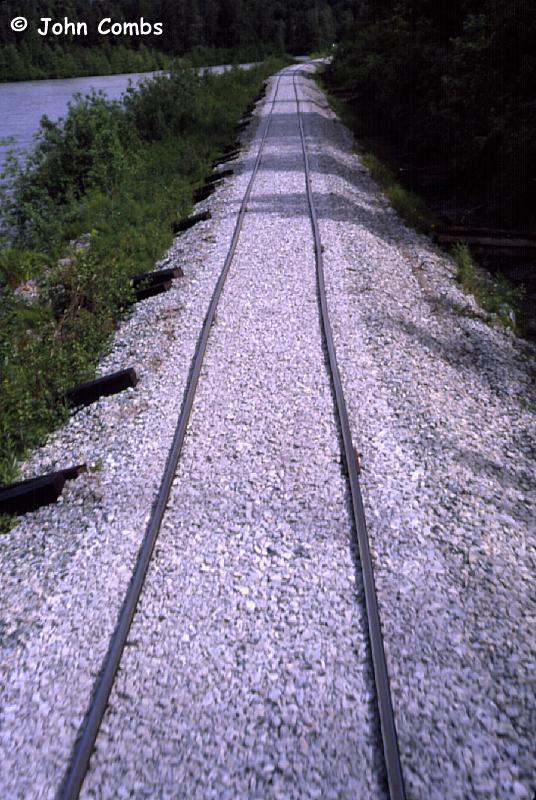
Question: What are sun kinks?
Answer: A section of
rail that elongates and bends out of alignment due to heat expansion.
Here are
two photographs of sun kinks along the Alaska Railroad (photo1, photo2). Incidentally, the first photo now
appears in Pearson Science for "College Physics" 2e,
by Knight, Jones, Field. Yeah for me!
Question: What
is a moose-proof switch?
Answer: We commonly
refer to a moose proof switch, as having a moose lock on the switch. It
works like this. Located between the head block ties, directly behind the
high banner switch stand is a foot lever that you step on, which then releases
a rigid metal bar that extends from the foot plate to the base of the closed
switch point. The bar has a J design that comes up underneath of the closed
point. Once the closed point is opened to allow access into the siding,
the metal bar has enough length to allow a full opening of the switch.
When closing the switch, the metal bar passes back through the foot pedal
housing until the closure of the switch has been made. There is a locking
system inside of the housing to ensure the point cannot open in the event
a moose is hit by a locomotive and drug through the switch, gapping the
switch points underneath a trains movement. We still use them on some switches,
but are a pain in the winter to keep them free of ice and snow. (Bruce
Gough).
Question: Why does the
Alaska Railroad change its trucks?
Answer: The reason was
commercial factors. The Blomberg was invented in 1939, and used by EMD
into the 1980 era. Lot's of them are still in use today. The AAR design
came out in 1940, and was built into the early 1970's. Many still in use
today also. The AAR designs were mostly adopted by the other locomotive
builders, but EMD used the AAR type A switcher truck on 90% of the switchers it
built until the 1970's.
(Don Marenzi).
Question: What was the longest freight train?
Answer: On April 29, 2013 Engineer Connor Keogh and Conductor Scott Siegmann took a 10,242-foot (1.94 miles) northbound train out of Anchorage. It consisted off 114 cars (74 loaded and 40 empty) and six locomotives. The train used distributed power with four locomotives in the front and two in the middle.
Question: What locations have continuous welded rail (CWR)?
Answer: John, about the welded rail, that's just about everywhere now, at least on the main. Sidings, yards, industries, and branch lines are jointed rail and probably will be forever. Most of the remaining jointed rail on the main is south of Anchorage. There are a few short sections between Anchorage and Fairbanks; I want to say one spot is up around Clear, there's another spot along the Susitna River, and a few short sections between Cantwell and Denali Park. There's also a short section from about MP 118 to MP 114.7. There may be more, but it's been a while since I've been up north. South of Anchorage, along Turnagain Arm, most of the curves have CWR now, though the rail is still jointed on straight sections. Whittier Branch, except for the Portage Tunnel and in Whittier, is all CWR. South of Portage is pretty much all jointed rail still. There's probably a few other spots I'm not thinking of, if the jointed rail is in good shape, it's not something you think too much about when you're going out the tracks because there are plenty of other things to do. -- James Ogden 12/8/2016
Question: What locations have concrete ties?
Answer: Around the yard, the Flint Hills loop tracks have concrete ties, the main does between CP1140 and CP1147, basically between the ends of the depot tracks. The depot tracks all have concrete ties. And way back in the port the two City Dock tracks have concrete ties. Other than that, all the ties around Anchorage yard are wood (although some tracks seem to be sitting on more mulch than wood). -- James Ogden 12/8/2016
Question: What is a winterization hatch?
Answer: A winterization hatch covers the radiator fan and a lever is moved to to blow the warm air back into the car body to prevent freezing.
Question: The specified Alaska Railroad branches are Palmer - A, Suntrana - D, Whittier - F, Eielson - G, Fairbanks - H branch, Anchorage -J Why there are no B, C, E, and I branches?
Answer: Frank Keller responds, "They were in existence at one time but have been eliminated. In looking at my old track chart I see Branch B was a 3 mile Branch to Jonesville removed in 1969. Looks like the Valdez terminal was "I". Not sure about C & E."
Question: The train used to leave the upper door in the vestibules open so we could take photos. This is no longer the case. Why?
Answer: The Federal Railroad Administration enforced 49 CFR Part 238.135 which said, "After April 5, 2016, all passenger train exterior side doors and trap doors must be closed when a train is in motion between stations..." The Alaska Railroad could apply for special approval from Washington
Associate Administrator for Railroad Safety/Chief Safety Officer to operate passenger trains with the door open between stations. However, they have chosen not to do so.
Question: Did F7 locomotives have custom made front plows?
Answer: All the Alaska A units had the EMD plow. The Anchorage shops had a large steel roller and they would roll large flairs and then weld them to the plow pilots. Super think steel too. One old head told me the steel roller was one of the largest in the country. - Mike G.
Question: Does the Alaska Railroad run a mixed freight/passenger train?
Answer: The ARR has a wavier to operate mixed trains, passenger/freight and is the only one in the US to do so, there can't be any Haz-Mat cars on the consist thought since it's partially a passenger train. So the reason for this in modern days is the northbound freight trains don't run on Thursdays and Saturdays. (keep note) Now a freight when built it has a certain amount of locomotives for the length/weight of the train. After a certain amount of cars more locomotives would be needed to pull, and provide enough air from the head end to the last car. Depending on a few things that I won't get in to right now, it could cost more to add one locomotive to an already long freight train than to add the cars to a train already heading north with more than enough power on that consist, that's were the AuRoRa comes in. Since there is no freight trains on Saturdays it also makes sense to utilize the AuRoRa since it's going to be the only northbound train. It used to be common practice on all railroads across North America to run mixed trains but as the years pass and new types of freight are created so are rules. Aside from heritage railroads that run freight as a revenue source, no Class 1 or Class 2 railroad aside from the ARR runs mixed passenger/freight trains. The ARR since it's beginnings has run mixed trains. You can see photos of the AuRoRa say in the1970s with freight cars on the end. Aside from the Whittier Shuttle there was about a 30 year span of where there were no mixed trains until 2009. I've filmed a lot of these mixed trains as it's a very unique ARR only operation. - Mike G.
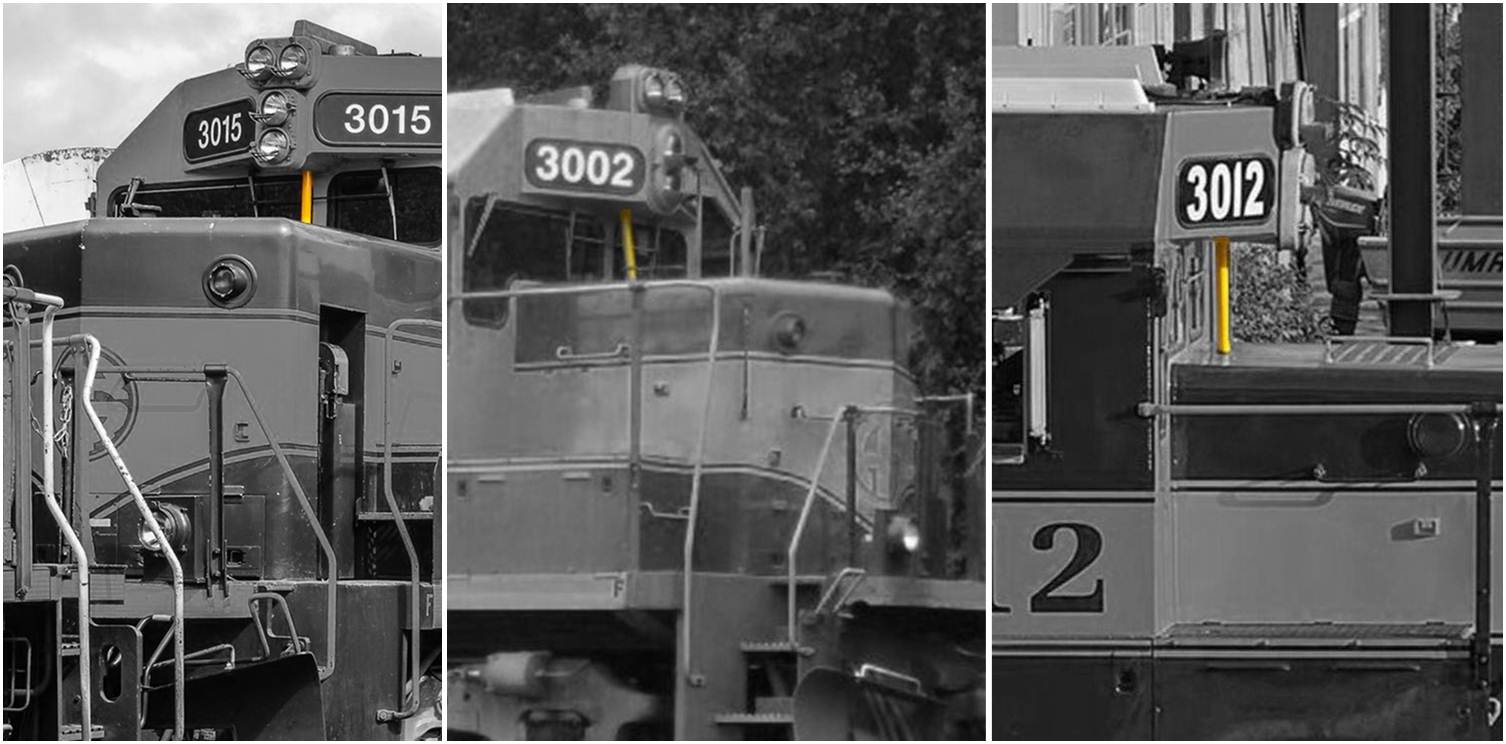
Question: What is the cylindrical post or conduit (yellow in the attached picture) between the short hood and the bottom of the number board housing, centered between the windows?
Answer: The conduit is used to carry the wires from the antennas and navigational equipment on the roof to the Positive Train Control (PTC) computers.
Question: How is intermodal traffic handled on the Alaska Railroad?
Answer: Historically the Whittier inbound intermodal is all Alaska Marine Lines (AML) containers. There are never trailers in Whittier. All containers and ISO flats that once they reach Anchorage, most get transferred to truck and delivered to the customer. Directly from the rail yard. That is our Container On Flat Car (COFC) and it's all old rebuild for the third time 53' flats and a variety of now 5 different 89'ish flats.
The trailer traffic all arrives in Anchorage on ship. Matson or TOTE. Local stuff is delivered direct by truck. The traffic to Fairbanks goes on rail as Trailer On Flat Car (TOFC). This is using the old 3-car unit sets of "spine" or "impac" cars. Ours DO NOT HAVE CONTAINER LOCKS, straight trailers only. They are unique too in that they are wired for power distribution for reefers or Keep From Freezing (KFF) service.
So:
COFC is anc-whi-anc
TOFC is anc-fbx-anc with maybe 10% COFC added
Carloads to change seasonally between winter and construction seasons. It also changes with the economy. Like 2020 there was a noticeable lack of steel buildings, drill pipe and other large industrial commodity. Spring usually sees a huge surge in lumber and building products. That was also way down this year.
Question: Why did the Alaska Railroad sell off their GP49s?
Answer: Well while it was a corporate decision I had a fair amount to do with it as a Mechanical Project Manager and then General Foreman - Anchorage Shops. They really didn't fit in as well as the GP40-2 / GP38 fleet which shared many parts of which the 49's were more orphaned in that regard. The D87 motors were more problematic, the radar wheel slip caused issues, some electronic modules were hard to get and generally the cost was higher and reliability lower than the other Geeps. When it came to culling down the roster it was evident that we could get rid of the 49's, keep the older Geeps and maintain a good parts / component compatibility and meet the transportation demands of the railroad. - Doug Ellison former General Foreman Anchorage Shop AKRR
Question: How high are containers stacked on a barge?
Answer: We have gone as high as six in the summer with empty containers’s. Five is normal. To keep them in place there is a hook on one side and an auto style twist lock.
Question: Why can the Alaska Railroad purchase SD70MACs, but the SD70Ace are used in the lower 48? I know the SD70Ace are Tier II, but I had read that the older units could not be sold after 2006 and it would make sense the Alaska Railroad is under the same rules.
Answer: Being a Class Il railroad the Alaska Railroad made a deal with the EPA saying they were allowed to purchase a locomotive that is only Tier I compliant as long as they eliminated enough older locomotives to keep the total fleet annual emissions the same as if the new locomotives had been Tier Il compliant. This is part of the reason the GP49s were surplused.
BACK